
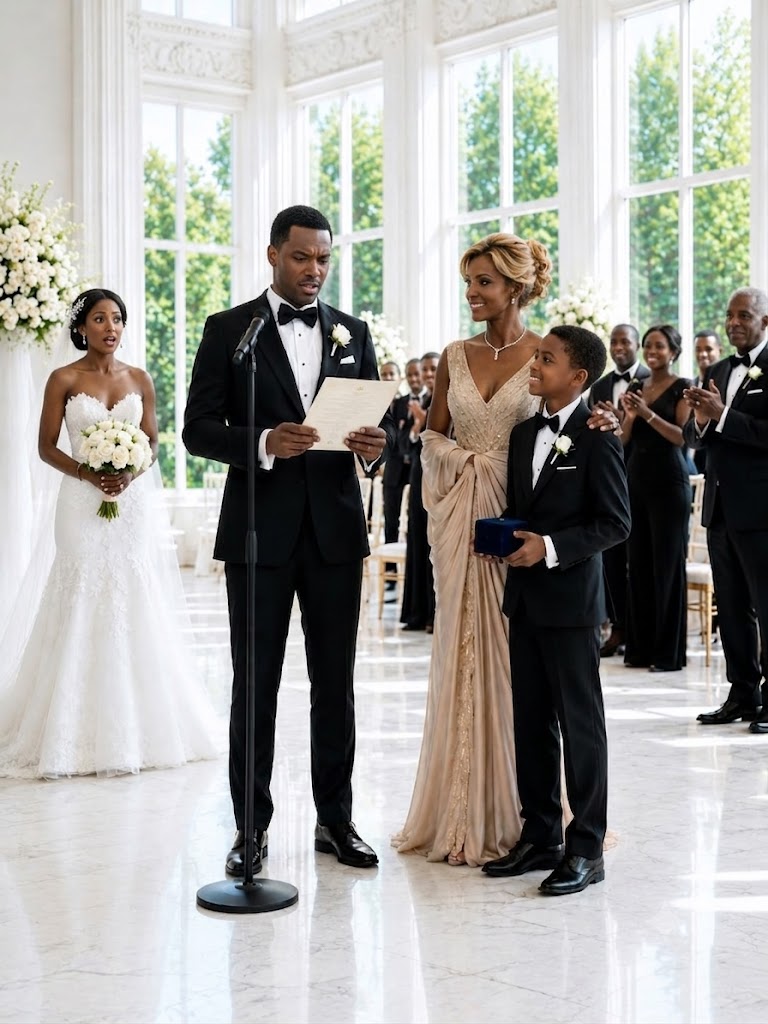
Part 1: The Invitation on the Porch
The wedding invitation arrived on a quiet Tuesday afternoon, tucked between a grocery advertisement and an electricity bill inside the mailbox of my small home in Cary, North Carolina.
The envelope was thick ivory paper with dark-green lettering pressed into the surface. For several seconds, I assumed it had been delivered to the wrong address because nothing in my current life arrived with hand-lined envelopes or wax seals.
Then I saw the name.
Nathaniel Cross.
My former husband was getting married.
I remained on the porch while the late-September wind moved through the maple trees along the street. I did not cry, although my fingers tightened around the envelope until the edge pressed against my palm.
My name is Allison Reed. I was thirty-eight years old, worked as an elementary-school librarian, and had spent the previous eighteen months rebuilding a life Nathaniel had abandoned with two suitcases and a carefully prepared explanation about needing freedom.
He never called his departure betrayal.
He called it honesty.
He never admitted that another woman already existed.
He described her as a colleague who understood the pressures of his consulting work.
Whenever I questioned late dinners, locked screens, or hotel charges, Nathaniel turned my concern into evidence that I was insecure.
“You are exhausted, Allison. You see danger whenever life becomes unfamiliar.”
“There is nothing happening with Camille.”
“You are making our marriage impossible because you refuse to trust me.”
His skill was not merely lying.
His skill was making another person apologize for noticing the lie.
The invitation confirmed he would marry Camille Bennett at the Hawthorne Conservatory in Raleigh, followed by a formal reception at a private country club. The ceremony would begin at four on Saturday afternoon.
Beneath my name appeared another.
Oliver Cross.
Our eleven-year-old son had been invited too.
That detail hurt more than Nathaniel’s remarriage.
He wanted us visible.
He wanted the former wife and nearly forgotten son sitting politely among white flowers while he introduced a new version of his life to colleagues, clients, and relatives. Our presence would allow him to appear generous, mature, and completely forgiven.
I carried the invitation into the kitchen and placed it beneath a bowl of apples.
Then I made dinner, checked Oliver’s homework, washed dishes, and tried to behave like a mother whose heart had not been disturbed by a piece of expensive paper.
Oliver discovered it while looking for tape.
He stood beside the counter with the invitation held in both hands.
“Dad is getting married?”
His voice contained no anger, which frightened me more than shouting would have.
“Yes.”
He studied Camille’s name.
Oliver remembered her.
Nathaniel had introduced Camille during our marriage as a senior project coordinator at Cross Advisory. After the separation, she appeared in photographs beside him at charity events and corporate dinners. Seven months after the divorce became final, they announced their engagement.
“Did he tell you?” Oliver asked.
“The invitation told me.”
He looked down again.
“My name is here.”
“It is.”
“Do we have to go?”
“No. We can decline.”
Oliver stayed silent for so long that I heard the refrigerator motor restart.
Then he said, “I want to attend.”
I pulled out a chair and sat across from him.
“Why?”
He rubbed one thumb over the raised lettering.
“Because Dad invited me.”
The answer carried everything he could not say aloud.
Perhaps Nathaniel wanted him there.
Perhaps the invitation meant his father had remembered him.
Perhaps standing in the same room would make Nathaniel acknowledge the birthdays, school events, and weekends he had forgotten.
Children continue hoping long after adults learn that hope can become another form of injury.
“The day may be difficult,” I warned him. “Your father will be busy, and he may not give you much attention.”
“I know.”
“People may ask uncomfortable questions.”
“I know.”
“You are allowed to change your mind.”
Oliver nodded.
“I still want to go.”
During the following week, he rarely mentioned the wedding. He completed school assignments, polished his dress shoes, and asked whether his navy blazer still fit.
He also began gathering items inside a small wooden box that had once held a pocketknife Nathaniel gave him during a camping trip.
Every time I entered Oliver’s bedroom, he closed the lid.
I did not force him to explain. Children sometimes require privacy before they discover the language for disappointment.
One evening, I saw a yellow notebook open across his desk. Dates had been written in neat columns, with several short sentences beside each one.
Oliver closed it when he noticed me.
“I am okay, Mom.”
Sometimes “I am okay” means a child has no safe way to say everything else.
I kissed his forehead and left the room.